
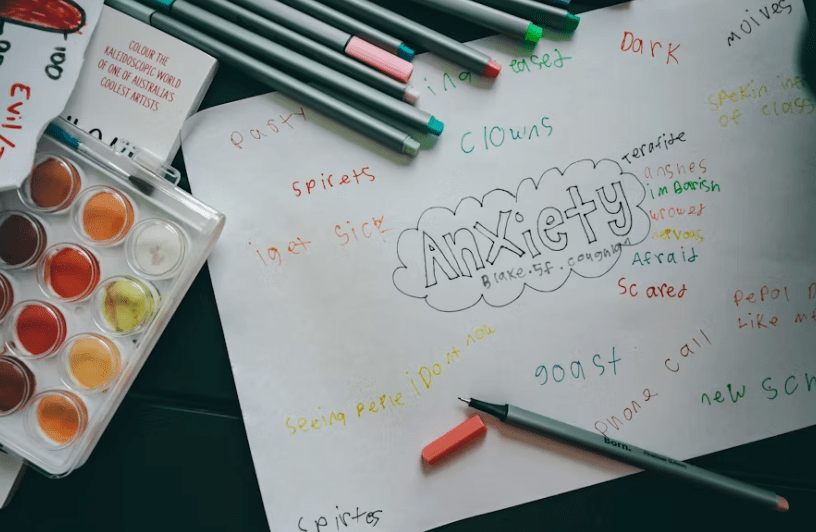
I know firsthand that childhood anxiety isn’t always a fleeting stage. For me, it wasn’t just “the jitters”, it felt like an early warning sign of something serious, a chronic mental health issue that was already setting up camp.
From articles and papers I’ve read or in meeting people in real life, therapists and experts do agree: while a little worry is a normal part of growing up, the kind that is persistent, excessive, and genuinely impairing your life isn’t. That’s a developmental anxiety disorder, and it absolutely requires early intervention. We can’t just wish it away.

When anxiety starts in childhood, you don’t just deal with it; you adapt to it. Your survival instincts kick in, and you learn to live by a new, restrictive set of rules. This creates an anxious personality, a collection of behaviours and emotional defences that are designed to minimize threat, even if they secretly maximize misery.
- The Default Setting: Over years, the constant alertness, the excessive worrying, and the need for control cease to feel abnormal. They become your default setting, the baseline of your existence. You become a highly proficient risk assessor, always scanning the horizon for potential threats, and this vigilance becomes synonymous with being responsible or cautious.
- The Problematic New Normal: You learn to live with the “BS.” Things that would shock or alarm someone else barely register for you because you’re so conditioned to emotional chaos. You develop a kind of psychological armor: the ability to smile right after something difficult happens and push the feelings in. This isn’t resilience; it’s emotional suppression.

Where Feelings Go to Live
This is the hardest part: your gut gets conditioned to be okay with it. When you constantly suppress stress, fear, and discomfort, those feelings don’t vanish, they simply retreat inward. They find a host in your body and your subconscious mind.
- Internalizing the Stress: The anxiety takes up residence. It makes a home there, in the tension in your shoulders, the chronic knot in your stomach, or the low-grade, constant physical arousal. It evolves from a passing emotion into a physical, chronic state.
- The Impossible Request: This is why it’s so impossibly hard to just “not be anxious.” It’s not a switch you can flip because the anxiety isn’t a visitor anymore; it’s a resident. It has shaped your coping mechanisms, your interpersonal style, and even your physical body. Asking a person conditioned this way to “just relax” is asking them to dismantle the protective structure they spent decades building just to survive.
Healing, in this context, isn’t just treating a symptom; it’s the difficult, incremental process of renovating your identity and convincing your deeply conditioned nervous system that the threat is, finally, gone.
Why Early Intervention Is Non-Negotiable
The single most critical reason to intervene early with childhood anxiety isn’t just to make a child happier now; it’s to prevent a temporary disorder from becoming a permanent personality structure.
When persistent, excessive anxiety is left unchecked, it doesn’t just hang around, it becomes a masterful architect, subtly rewiring the child’s entire operating system. This long-term adaptation is why early action is not just preferred, but non-negotiable.
1. Stopping the Anxiety from Becoming the Self
The brain is incredibly plastic in childhood. If the constant alarm of anxiety is the background noise, the child’s developing personality and coping mechanisms are built to accommodate that noise.
- Personality Solidification: The behaviors that start as avoidance tactics (e.g., social withdrawal, excessive planning, rumination) gradually solidify into personality traits. The child doesn’t just feel anxious; they become the “worry wart,” the “risk assessor,” or the “perfectionist.” This makes “just relaxing” nearly impossible later in life because they are being asked to dismantle the protective identity they spent decades building to survive.
- The Problematic New Normal: As you noted, the child becomes so conditioned to the high baseline of stress that they learn to live with the “BS.” They push feelings inward and learn to smile right after something difficult happens. This emotional suppression allows the anxiety to move from a surface symptom to a resident in the body and mind, creating that chronic, internalized state that is so resistant to change in adulthood.
2. Interrupting the Vicious Cycle of Comorbidity
The stakes are raised because untreated childhood anxiety is a powerful predictor for future mental health issues.
- The Path to Depression: According to the Great Rocky Mountain Study, roughly 50% of children with an anxiety disorder will go on to develop another psychiatric disorder, most commonly depression, by young adulthood. Untreated anxiety often leads to a life of narrowed opportunities, disappointment, and avoidance, a perfect breeding ground for subsequent depressive episodes.
- Preventing Functional Impairment: Without intervention, anxiety can lead to severe life impairment: school refusal (a major obstacle to education), social isolation (damaging to social skill development), and the inability to pursue age-appropriate challenges. Early treatment corrects these maladaptive patterns before they fundamentally derail a life trajectory.
3. Harnessing Developmental Plasticity
Childhood offers a crucial window for effective, lasting change. The younger the brain, the more easily it can be rewired.
- CBT as a Foundation: Interventions like Cognitive Behavioral Therapy (CBT) and Graduated Exposure are highly effective because they teach the child to challenge anxious thoughts and face fears while their brain is still highly adaptable. We are essentially giving the child the emotional regulation toolkit early, strengthening the rational prefrontal cortex to override the reactive amygdala.
- Breaking the Reinforcement Loop Early: When parents and therapists intervene, they stop the negative reinforcement cycle (avoidance → temporary relief → stronger fear) before it becomes the dominant strategy for coping with life.
Treating anxiety early is not just a form of relief; it is a profound act of prevention. It ensures that a temporary developmental hurdle does not solidify into a restrictive, chronic identity that limits potential for a lifetime.

My biggest takeaway? Treating anxiety early is not about getting rid of all discomfort; it’s about giving a child the chance to build a resilient emotional framework. It’s about ensuring that those early anxious patterns don’t solidify and shrink their life forever. We have the tools, and we owe it to them, and to ourselves, to use them.
~Mallika ❤
 In the Quiet Between
Leave a comment